

PROCESS CONTINUITY
What Happens When a Business Process Lives in One Person’s Head?
Help the person everyone depends on by understanding their most time-consuming work, capturing the decisions that matter, and giving someone else a practical way to help.

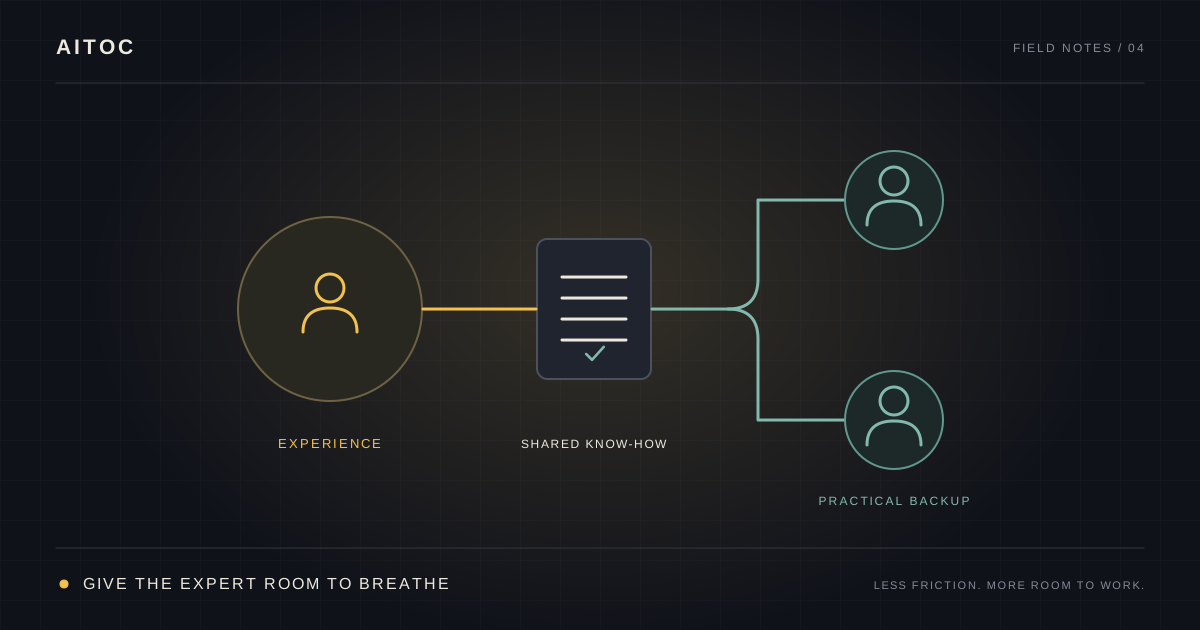
“Ask Sarah. She knows how that works.”
Every company seems to have a Sarah.
She knows which customer needs a different report, which job reference the crew meant, and why those hours should not go to payroll yet. When something does not fit, people ask her.
That experience is valuable. The difficulty starts when routine work cannot move without borrowing a piece of her day.
Then someone suggests writing it all down. Sarah, who is already busy keeping things moving, gets another job: create the manual.
I would start somewhere smaller: which task would she most like to stop spending so much time on?
The aim is to give her breathing room and the business reliable backup. Her experience still matters.
Find what actually consumes her time
If Sarah can point to the task straight away, we can start with a conversation about it. Ask her to show a recent example: what arrived, what she checked, where she had to chase someone, and what she handed over.
If she is unsure, a Time Study helps. Sometimes the obvious weekly report takes less time than the small interruptions surrounding it: finding a job number, answering the same question, or correcting an incomplete record.
A spreadsheet is enough to begin. Record the activity, time spent, and why it was needed. Include recurring work and a representative period, rather than treating one day as the whole picture.
Our RAFAI Time Study app is another option. You can set it up in about ten minutes and log activities on the spot. Activity data stays on your phone and is not sent to us. You control any export and can choose to share it during an Automation ROI Audit.
Time spent is a starting point, not an automatic instruction to automate. We also check what the work achieves, what could go wrong, and whether changing it would create enough benefit.
Learn from the work without assigning a writing project
For a complex process, we can shadow Sarah while she does it. That lets us see the real decisions without asking her to recreate the entire job afterwards.
There will still be questions. Some rules need explaining, and she needs a chance to check that we understood them. The point is to do the mapping work with her, rather than hand her a blank document and wait.
Think about giving someone directions along a route you drive every day. You may say “turn after the old depot” without realizing the sign came down years ago. Watching someone follow the route reveals which landmarks you take for granted.
It does not mean you gave bad directions on purpose. Familiarity makes some details almost invisible.
The same thing happens when Sarah checks a customer note or pauses before approving a correction. Those small decisions can explain why someone else gets stuck following the official steps.
Capture the part someone else needs
Consider this illustrative instruction:
Check the job report and send it to payroll.
A colleague may understand every word and still be unable to do the job. Which report? What counts as checked? What happens if the hours changed after approval?
A useful instruction puts those answers beside the task:
- where to find the current report;
- which details must be present;
- who approves the hours;
- where incomplete reports go for correction;
- how to tell the accepted record reached payroll.
Add the customer exception that regularly causes trouble. Leave unrelated history out of the way.
Not every click needs a paragraph. Give more attention to the decisions where a misunderstanding causes delay, rework, or a consequential mistake.
Sarah may still be the right person to approve an unusual case. That is different from needing her to find every report or explain the same routine check each Friday.
Give a colleague a realistic practice run
Choose someone with the relevant skills and normal system access. Walk them through the work, let them practise, then see how they handle a normal case and a familiar exception using the instructions.
When they need help, ask why.
Perhaps an instruction is missing. Perhaps they need more practice. Perhaps their account cannot see the customer note. Or perhaps this case really should go to Sarah.
A question is useful feedback. It is not automatically a defect in the document or a failure by the trainee.
Success means the colleague can handle the agreed routine work and recognize when to ask for help. It does not mean they suddenly have Sarah’s years of experience. Keep practice away from live consequences where an error would be difficult to undo.
For a starting structure, use the free SOP toolkit. Keep the guidance somewhere people can find it, and name who updates it when the work changes.
Then remove work that should not keep coming back
Mapping may reveal that the same information is entered twice, the same missing field is chased repeatedly, or the same report is assembled from several tools.
Those are candidates for improvement. Some steps can disappear. Some can be made easier with better instructions or collection forms. Others may be suitable for automation once the inputs and decisions are understood.
An automated step still needs someone to handle the cases it cannot complete. We should make those cases visible and explain what the person needs to do next.
The outcome worth aiming for is a Friday when Sarah can finish her own work because the routine report no longer needs six interruptions to get through.
Start by asking her which task would make that difference. If she does not know yet, start with the Time Study. You can understand one useful piece of the work without documenting the whole company first.
Denis Rafailov
Denis has spent 14 years building business software and operational automation. AITOC uses this material to help operators make better workflow decisions before anyone recommends a build.